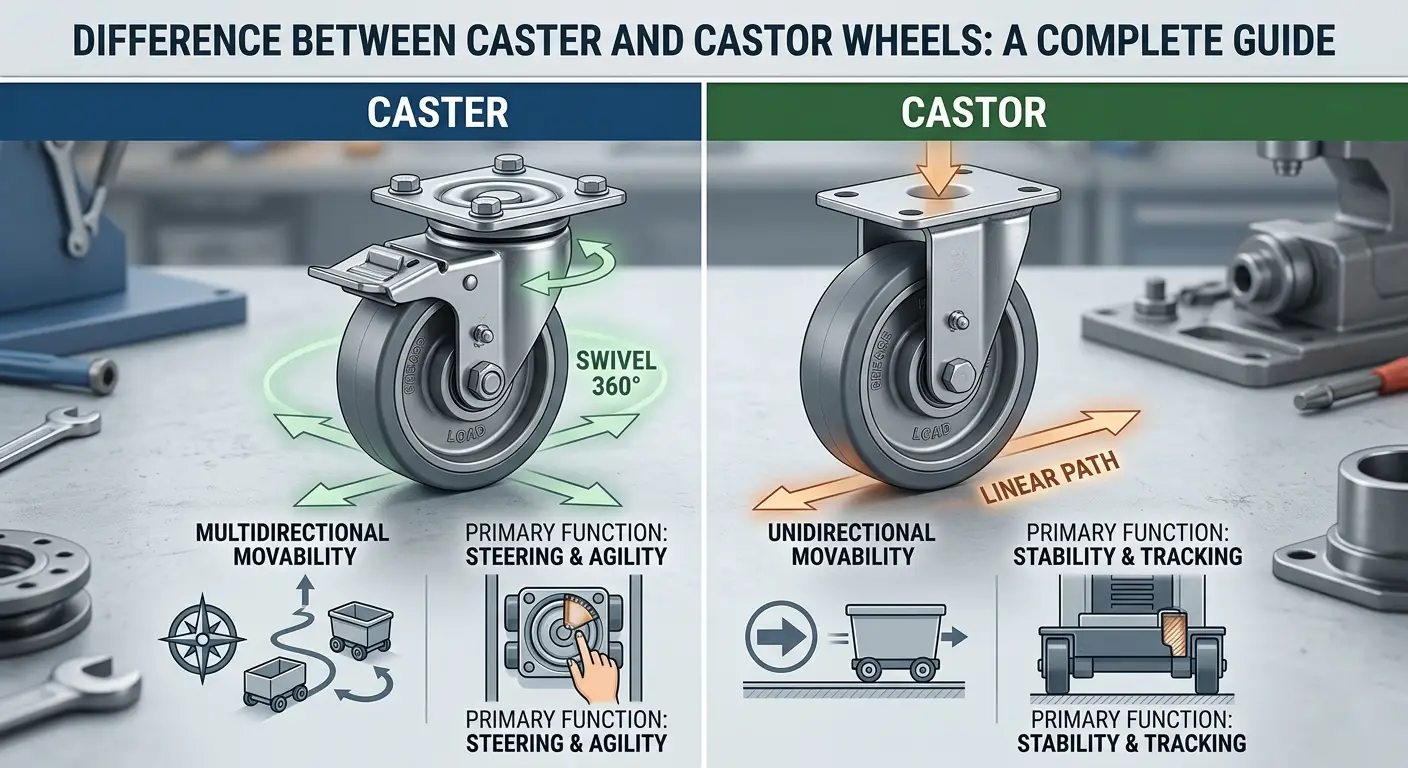
Difference Between Caster and Castor Wheels: A Complete Guide
When it comes to material handling, industrial mobility, and ergonomic workplace design, the terms caster and castor wheels often create confusion. Many people wonder whether they represent two different components or if it’s simply a spelling variation.
In this post, we’ll break down the difference between caster and castor wheels, explain their functions, and help you choose the right wheels for your applications. We’ll also show why Flexpipe’s caster wheels are a top choice for manufacturing, logistics, warehousing, and lean production environments.
Caster vs Castor Wheels: What’s the Real Difference?
1. Caster vs Castor, It’s Just Spelling
The primary difference between caster and castor is linguistic, not mechanical.
-
“Caster” is the common spelling used in American English.
-
“Castor” is a widely used variant in British English.
Both terms refer to the same component:
A wheel assembly that allows equipment or structures to move smoothly and rotate in multiple directions.
2. No Technical Difference
From an engineering standpoint, there is no difference between a caster wheel and a castor wheel. Whether it’s spelled caster or castor, it performs the same function, allowing mobility with ease, stability, and directional control.
3. Why the Confusion Exists
The confusion often arises because:
-
Some industries prefer the American spelling (e.g., manufacturing, warehousing).
-
Others use the British spelling in product catalogs, manuals, or academic documents.
-
The word “castor” is also associated with castor oil, adding to the ambiguity.
But in material handling, both spellings mean the same thing.
Types of Caster (Castor) Wheels
Regardless of the spelling, caster wheels come in multiple types based on their movement, material, and application.
1. Swivel Casters
-
Rotate 360°
-
Ideal for tight maneuvering
-
Common in workstations, carts, and equipment that need frequent repositioning
2. Rigid (Fixed) Casters
-
Move in a straight line
-
Provide excellent stability and load-bearing capacity
3. Locking Casters
-
Include wheel brakes or swivel locks
-
Useful in mobile workstations and assembly lines
4. Heavy-Duty Casters
-
Support large loads
-
Common in industrial trolleys, machine bases, and material-handling units
What Materials Are Caster Wheels Made Of?
Caster wheels are available in several materials depending on the environment:
-
Polyurethane: Quiet, floor-friendly, durable
-
Rubber: Shock-absorbing and suitable for uneven floors
-
Nylon: High strength and impact-resistant
-
Steel / Metal: Heavy-duty and long-lasting
-
Phenolic resin: Heat-resistant and ideal for harsh industrial environments
Applications of Caster (Castor) Wheels
Caster wheels are used across industries for:
-
Assembly line carts
-
Lean manufacturing structures
-
Conveyor support tables
-
Warehouse picking carts
-
Dollies and trolleys
-
Mobile shelving
-
Workstations and ergonomic equipment
-
Medical and laboratory equipment
Their versatility makes them essential for any environment that requires movement and flexibility.
Why Choose Flexpipe’s Caster Wheels?
If you’re looking for durable, ergonomic, and high-performance caster wheels for industrial, commercial, or lean manufacturing applications, Flexpipe’s Caster Wheels offer a superior solution.
Key Benefits of Caster Wheels:
1. Built for Lean Manufacturing
Flexpipe designs casters specifically for modular structures like flow racks, kitting carts, workstations, and mobile conveyors.
2. Exceptional Durability
Made from high-quality industrial materials, Flexpipe casters withstand:
-
Heavy loads
-
Continuous movement
-
High-impact environments
3. Smooth and Silent Operation
Low rolling resistance ensures effortless mobility with minimal noise, perfect for busy manufacturing floors.
4. Multiple Options for Every Application
Flexpipe offers:
-
Swivel casters
-
Fixed casters
-
Brake casters
-
Anti-static casters
-
Heavy-duty casters
All available in different sizes and load capacities.
5. Perfect Fit for Modular Pipe & Joint Systems
Flexpipe casters integrate seamlessly with their entire modular hardware lineup, making it easy to build or modify structures as needed.
Conclusion
The difference between caster and castor wheels is simply a matter of spelling preference, American vs. British English. Mechanically, they are the same component used widely in manufacturing, warehousing, logistics, and countless industrial applications.
If you’re building mobile workstations, carts, racks, or any modular structure, choosing high-quality caster wheels is essential for safety, efficiency, and long-term reliability.
That’s why Flexpipe’s caster wheels are a trusted choice. They provide durability, smooth movement, and perfect compatibility with modular systems designed for lean manufacturing environments.
Upgrade your mobility systems today with Flexpipe’s industrial-grade caster wheels!
Recent Articles