What is Lean Management? Powerful Benefits That Transform Businesses
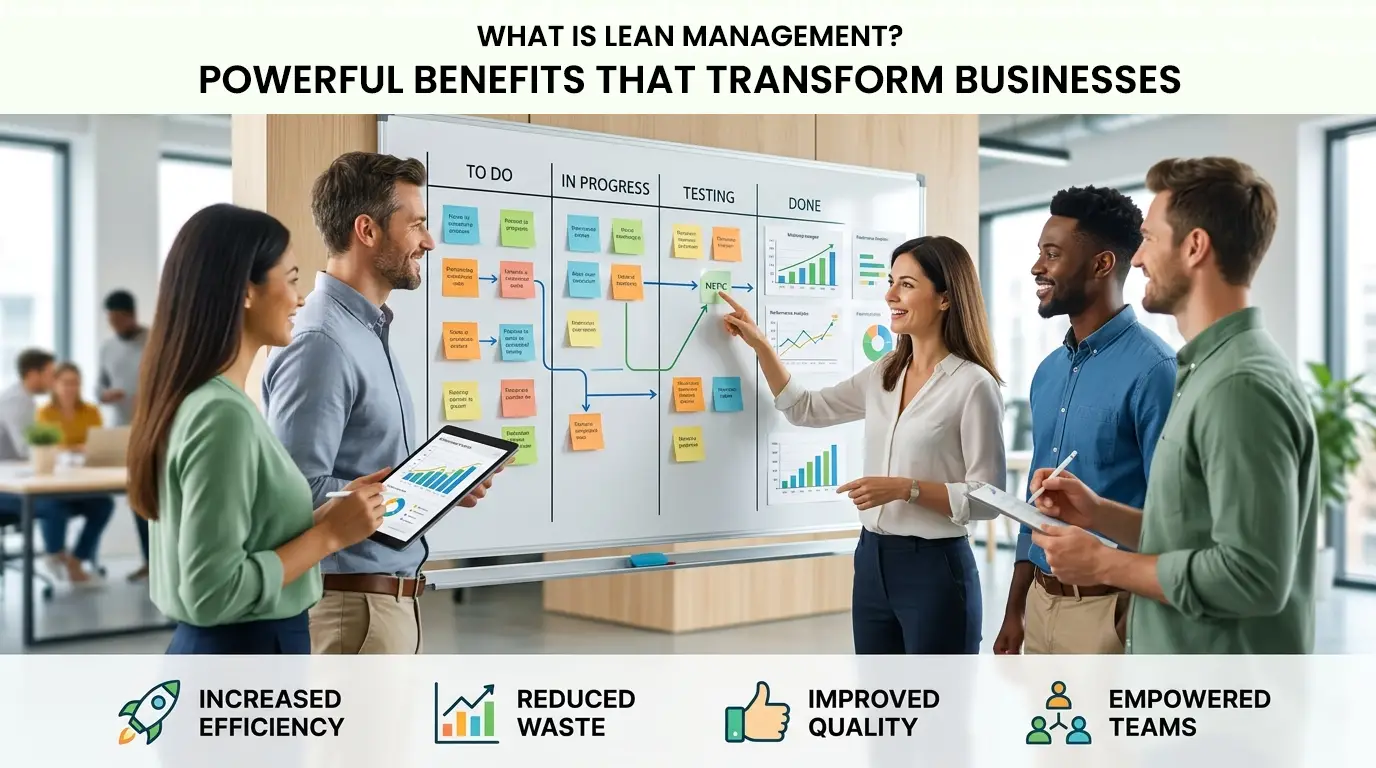
If you’ve ever wondered what Lean Management is, you’re not alone. It’s one of the most powerful business strategies used worldwide to improve efficiency, reduce waste, and deliver more value to customers.
Lean Management is a systematic approach that focuses on continuous improvement and the elimination of waste in every business process. Its main goal is simple: maximize value while minimizing resources.
Instead of making big, risky changes, Lean encourages small, steady improvements over time. These incremental changes add up, helping organizations become more efficient, productive, and customer-focused.
At its core, Lean Management revolves around three key ideas:
- Deliver value to customers
- Remove unnecessary steps (waste)
- Continuously improve processes
This approach doesn’t just apply to factories; it’s used in healthcare, IT, logistics, and even startups.
History and Origins of Lean Management
Toyota Production System Explained
Lean Management originated from the Toyota Production System (TPS) in post-World War II Japan. Toyota engineers developed a system focused on eliminating waste and improving workflow efficiency.
Their goal? Produce high-quality vehicles with minimal resources.
This revolutionary system introduced concepts like:
- Just-in-Time production
- Continuous improvement (Kaizen)
- Respect for people
These ideas became the foundation of Lean Management.
Evolution Across Industries
Over time, Lean expanded beyond manufacturing.
Today, it’s used in:
- Healthcare (to reduce patient wait times)
- Software development (Agile & DevOps)
- Retail and logistics
Lean has become a universal management philosophy for improving performance across industries.
Core Principles of Lean Management
Lean Management is built on five essential principles:
Identify Value
Understand what the customer truly values and is willing to pay for.
Value Stream Mapping
Analyze every step in your workflow to identify waste.
Continuous Flow
Ensure processes run smoothly without delays or bottlenecks.
Pull System
Produce only when there is demand, no overproduction.
Continuous Improvement (Kaizen)
Encourage ongoing improvements at every level of the organization.
Key Concepts in Lean Thinking
The 8 Types of Waste
Lean identifies eight types of waste (known as “Muda”):
- Overproduction
- Waiting
- Transportation
- Overprocessing
- Inventory
- Motion
- Defects
- Unused talent
Eliminating these wastes is central to Lean success.
Customer Value Focus
Everything in Lean revolves around customer value. If a process doesn’t add value, it’s considered waste and should be removed.
Benefits of Lean Management
Improved Efficiency
Lean removes unnecessary steps, making workflows faster and smoother.
Cost Reduction
By eliminating waste, companies save money on materials, time, and labor.
Better Quality
Fewer errors lead to higher-quality products.
Employee Engagement
Lean empowers employees to contribute ideas and improvements.
Organizations that adopt Lean often see higher productivity and faster response to customer needs.
Lean Management Tools and Techniques
Some of the most popular Lean tools include:
- 5S System – Organizes the workplace
- Kanban – Visual workflow management
- Just-in-Time – Produce only what’s needed
- Value Stream Mapping – Analyze workflows
These tools help businesses implement Lean principles effectively.
Lean Management in Different Industries
Manufacturing
The most common application is improving production lines and reducing waste.
Healthcare
Streamlines patient care and reduces waiting times.
IT and Software
Improves development cycles and reduces inefficiencies.
Challenges in Implementing Lean
Lean isn’t always easy to implement.
Common challenges include:
- Resistance to change
- Lack of training
- Poor leadership support
- Misunderstanding Lean principles
Success requires commitment from all levels of the organization.
Role of Modular Systems in Lean Manufacturing
What is a Modular System?
A modular system is a flexible setup made from standardized components that can be easily assembled, modified, and reused.
Why Flexibility Matters
Lean environments require constant improvement. Fixed systems can slow down progress, while modular systems allow quick changes and adaptability.
How Flexpipe Modular System Supports Lean
One of the best ways to implement Lean principles in manufacturing is through modular solutions like Flexpipe Modular System.
Flexpipe offers a reconfigurable material handling system made of steel pipes and joints.
These components can be assembled into:
- Workstations
- Flow racks
- Carts
- Storage systems
What makes it powerful for Lean?
Key Features of Flexpipe
- No welding required
- Fully reusable components
- Easy to assemble and modify
- Supports ergonomic designs
Benefits for Lean Workflows
Flexpipe’s system directly supports Lean by:
- Reducing waste through reusability
- Enabling quick layout changes
- Improving workflow efficiency
- Supporting continuous improvement
In fact, modular systems like Flexpipe can help teams reduce waste and improve productivity by enabling faster adaptation to changes.
Real-World Applications of Lean with Modular Systems
Companies use modular systems to:
- Create flexible assembly lines
- Improve warehouse organization
- Optimize material flow
- Implement 5S and Kaizen practices
This flexibility makes Lean implementation faster and more effective.
Future Trends in Lean Management
Lean continues to evolve with:
- Automation and AI
- Smart factories
- Digital twins
- Sustainable manufacturing
The future of Lean is all about combining efficiency with innovation.
Conclusion
Understanding what Lean Management is is essential for any organization aiming to stay competitive in today’s fast-paced world. By focusing on value, eliminating waste, and continuously improving processes, Lean helps businesses achieve higher efficiency and better customer satisfaction.
When combined with innovative solutions like Flexpipe’s Modular System, Lean becomes even more powerful. The flexibility, reusability, and adaptability of modular systems make them a perfect fit for modern Lean environments.
If your goal is to build a smarter, more efficient, and future-ready operation, Lean Management is the way forward.
FAQs
- What is Lean Management in simple terms?
Lean Management is a method to improve efficiency by removing waste and focusing on customer value.
- What are the 5 principles of Lean Management?
Value, value stream, flow, pull, and continuous improvement.
- Where is Lean Management used?
It’s used in manufacturing, healthcare, IT, logistics, and more.
- What is waste in Lean?
Any activity that doesn’t add value to the customer.
- How does Flexpipe support Lean?
Flexpipe provides modular systems that enable flexible layouts, reduce waste, and support continuous improvement.
- Is Lean Management only for manufacturing?
No, it applies to all industries.
Recent Articles