8 Wastes of Lean: The Complete Guide to Eliminating Inefficiency
The 8 Wastes of Lean form the foundation of lean manufacturing and continuous improvement strategies used across industries worldwide. Lean thinking focuses on maximizing customer value while minimizing waste. In simple terms, anything that does not add value from the customer’s perspective is considered waste, and waste costs time, money, and morale.
Understanding and eliminating these wastes allows organizations to improve efficiency, enhance quality, and reduce operational costs. Even better, when lean principles are combined with adaptable solutions like Flexpipe’s modular system, companies gain the flexibility needed to sustain lean improvements over time.
Understanding the Concept of the 8 Wastes of Lean
Overview of Lean Manufacturing Principles
Lean manufacturing originated from the Toyota Production System and emphasizes:
- Continuous improvement (Kaizen)
- Respect for people
- Flow and pull-based production
- Waste elimination
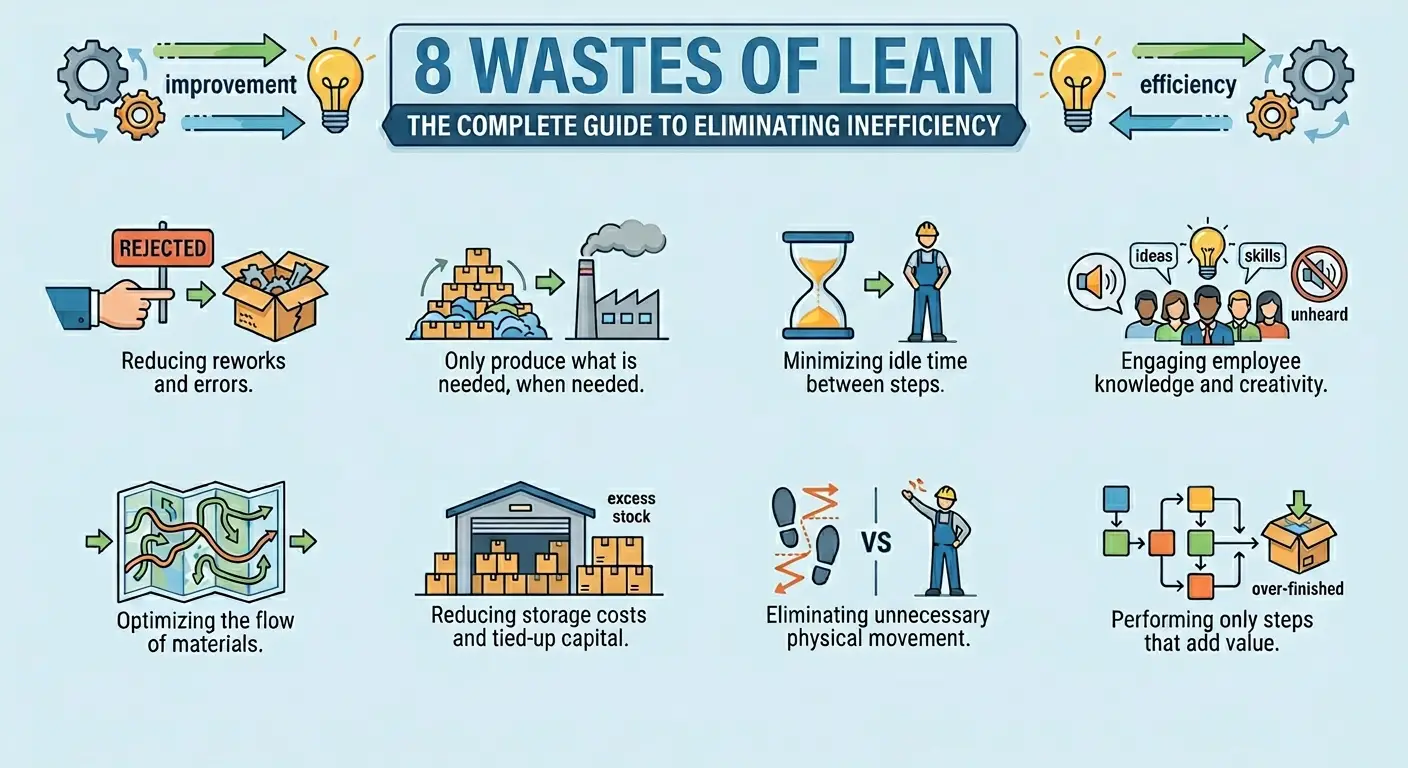
The 8 Wastes of Lean, often remembered by the acronym DOWNTIME, highlight the most common sources of inefficiency found in processes, layouts, and systems.
Waste #1: Defects
How Defects Impact Quality and Cost
Defects result in rework, scrap, customer complaints, and warranty claims. They consume materials, labor, and time, without delivering value. Over time, defects damage brand reputation and employee confidence.
How Flexpipe Reduces Defects Through Ergonomic Design
Flexpipe modular workstations are designed to improve ergonomics and process consistency. Adjustable heights, standardized layouts, and mistake-proof designs help operators work comfortably and accurately, reducing human error and defect rates.
Waste #2: Overproduction
Why Producing Too Much Hurts Lean Operations
Overproduction is often considered the worst of the 8 Wastes of Lean because it leads to excess inventory, storage costs, and hidden defects. Producing more than needed ties up cash and floor space.
Flexpipe Modular Systems for Just-In-Time Production
Flexpipe enables quick reconfiguration of production lines, making it easier to align output with demand. Modular flow racks and assembly stations support Just-In-Time (JIT) manufacturing without costly fixed infrastructure.
Waste #3: Waiting
Hidden Costs of Idle Time
Waiting occurs when people, machines, or materials are idle. This waste is often invisible but extremely costly, slowing lead times and reducing throughput.
Eliminating Waiting with Flexible Workstations
Flexpipe’s modular layouts improve material flow and workstation accessibility. By placing tools and materials exactly where they’re needed, waiting time between tasks is significantly reduced.
Waste #4: Non-Utilized Talent
The Most Overlooked Lean Waste
When employees’ ideas, skills, and creativity are ignored, organizations miss valuable improvement opportunities. This waste leads to disengagement and high turnover.
Empowering Teams with Reconfigurable Systems
Flexpipe empowers teams to participate in continuous improvement. Employees can easily modify and improve their own workstations, encouraging ownership, innovation, and problem-solving.
Waste #5: Transportation
Excess Movement of Materials
Unnecessary transportation increases the risk of damage, delays, and confusion. Long travel distances between processes add no value.
Optimized Flow Using Flexpipe Structures
With Flexpipe, manufacturers can design compact layouts using carts, conveyors, and flow racks that reduce travel distances and streamline material movement.
Waste #6: Inventory
Risks of Excess Inventory
Too much inventory hides problems like poor quality and long changeover times. It also increases storage, handling, and obsolescence costs.
Modular Racking for Lean Inventory Control
Flexpipe gravity flow racks support FIFO (First-In, First-Out) inventory management, improving visibility and reducing excess stock while maintaining smooth production flow.
Waste #7: Motion
How Poor Ergonomics Create Waste
Unnecessary bending, reaching, and walking strain workers and slow down processes. Over time, this leads to injuries and lost productivity.
Ergonomic Workstations with Flexpipe
Flexpipe’s adjustable workstations are designed around the operator, minimizing motion waste while improving safety and efficiency.
Waste #8: Extra Processing
Doing More Than the Customer Requires
Extra processing includes redundant steps, excessive inspections, or overengineering. These activities consume resources without increasing value.
Simplifying Processes with Modular Design
Flexpipe allows teams to build only what’s needed, no more, no less. Modular systems simplify workflows and eliminate unnecessary complexity.
Why Flexpipe’s Modular System is Ideal for Lean Manufacturing
Flexpipe’s modular system aligns perfectly with lean principles by offering:
- Fast implementation
- Easy reconfiguration
- Scalable designs
- Long-term cost savings
Unlike fixed welded structures, Flexpipe grows and evolves with your operation.
Conclusion
The 8 Wastes of Lean provide a clear roadmap for eliminating inefficiencies and building smarter operations. When these principles are combined with Flexpipe’s modular system, organizations gain the agility needed to sustain continuous improvement.
By reducing waste today, you create a more efficient, flexible, and competitive operation for tomorrow.
FAQs
- What are the 8 Wastes of Lean?
The 8 Wastes of Lean include Defects, Overproduction, Waiting, Non-Utilized Talent, Transportation, Inventory, Motion, and Extra Processing. - Why are the 8 Wastes of Lean important?
They help organizations identify inefficiencies and improve productivity, quality, and profitability. - How does Flexpipe support lean manufacturing?
Flexpipe provides modular, flexible systems that adapt to lean improvements and reduce multiple forms of waste. - Which waste is the most harmful?
Overproduction is often considered the most damaging because it triggers other wastes. - Can lean principles apply outside manufacturing?
Yes, lean concepts apply to healthcare, logistics, offices, and service industries. - How quickly can Flexpipe systems be implemented?
Most Flexpipe solutions can be designed and installed much faster than traditional fixed structures.
Recent Articles