Difference between Carton Flow Rack & Gravity Flow Rack
In modern warehousing and distribution environments, efficiency, speed, and accuracy in order picking are critical. Flow rack systems, whether carton flow or gravity flow, are among the most effective ways to reduce travel time, cut down on walking distances, and maintain a FIFO (First In, First Out) picking methodology. Choosing the right flow rack system can influence throughput, inventory management, and total cost of ownership.
What is a Carton Flow Rack?
A Carton Flow Rack is a specialized flow rack system designed to handle cartons, boxes, totes, or bins. The typical setup includes multiple parallel lanes of rollers or wheels mounted on an incline. New cartons are loaded from the back (or loading side), they roll forward by gravity, and picks are taken from the front (picking side). The incline must be carefully calibrated so the cartons flow smoothly but do not race forward dangerously.
Key aspects:
- Used extensively in e-commerce, fast-moving consumer goods, pick modules.
- Roller spacing (pitch) is designed for carton width.
- Often includes dividers, lane separators, stoppers, brakes.
- Supports high-density picking and rapid replenishment.
What is a Gravity Flow Rack?
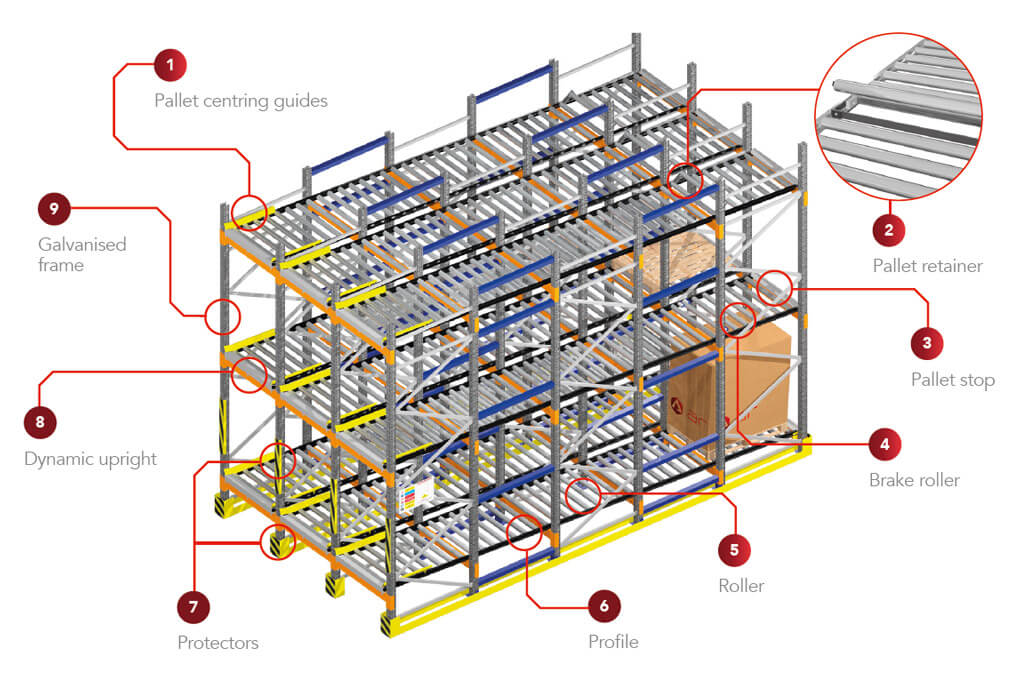
Gravity Flow Racks is a broader term, sometimes used synonymously with carton flow, but more often used when referring to heavier or larger loads (pallets, heavy cartons) or modular flow systems. The principle is still the same: gravity-powered movement, inclined lanes, and FIFO operation.
Key aspects:
- Can handle larger units or heavier loads.
- Often built with sturdier rollers, structural steel, or robust frames.
- May include features like roller bearings rated for high load, adjustable lanes, or rails for heavier duty performance.
- Suited for applications like parts bins, automotive components, or bulk items.
Core Similarities Between Carton Flow & Gravity Flow
Despite differences, both systems share several fundamentals:
- They rely on gravity (inclined lanes) to move load forward.
- They enforce FIFO, first item loaded is first picked.
- They reduce picker travel distance by bringing items to the picker.
- They typically use rollers, wheels, or tapered lanes.
- Both systems require proper inclination and maintenance to function smoothly.
Key Differences Between Carton Flow & Gravity Flow
Load type and size
- Carton Flow is optimized for smaller units, cartons, totes, bins.
- Gravity Flow may handle heavier items or mid-size loads beyond standard cartons.
Lane structure and roller pitch
- In carton flow, roller pitch is tight (rollers closer) to prevent small boxes from getting stuck.
- Gravity flow may use wider roller spacing or heavier rollers, accommodating heavier loads.
Flow speed and control
- Carton flow often includes flow-controls, brakes, or dampers to regulate speed.
- Gravity flow may rely on sturdier rollers, stoppers, or more rigid frames to handle momentum.
Support and framing
- Carton flow racks might be integrated into conventional selective rack frames.
- Gravity flow racks often require reinforced structural steel frames or more robust supports.
Scalable flexibility
- Carton flow tends to be modular and adjustable for SKU changes.
- Gravity flow systems might be less flexible, though modern modular gravity flow solutions are changing this.
Advantages & Limitations, Side by Side
| Feature | Carton Flow | Gravity Flow |
| Advantages | High pick density, reduced walking, modularity | Handles heavier loads, robust structure, good for mixed loads |
| Limitations | Limited to lighter cartons, needs precise adjustment | Higher cost, less fine-tuned for very small cartons, less modular in older designs |
How to Choose Between the Two
When selecting between carton flow and gravity flow:
- Analyze your SKU mix, If most SKUs are small cartons, carton flow is better.
- Volume & throughput, High velocity SKUs benefit more from carton flow lanes.
- Weight & size, For bulkier or heavier items, lean toward gravity flow.
- Modularity & reconfiguration needs, If frequent layout changes are expected, prioritize modular systems like Flexpipe.
Introducing Flexpipe’s Flow Rack System
Flexpipe is a leader in modular flow rack systems, offering highly configurable, durable, and efficient solutions that blend the best of carton flow and gravity flow. The systems allow custom lane width, roller configurations, and structural supports, while being easy to build, rework, or expand.
Flexpipe’s Carton Flow Modules
- Designed with precision roller lanes, adjustable width.
- Compatible with standard rack frames or standalone flow rack builds.
- Flow lanes include optional brakes, chutes, and dividers.
- Easy to mount or retrofit into existing installations.
Flexpipe’s Gravity Flow Options
- Heavy-duty flow lanes for mid-size or heavier loads.
- Structural tubing (Flexpipe’s signature modular tubing) acts as frame support.
- Systems can scale from light to heavy usage, combining lanes for mixed load profiles.
Why Opt for Flexpipe Over Conventional Racks?
- Speed of implementation & reconfiguration, no welding required.
- Aesthetic finishes, modular powder-coated tubing give a polished look.
- Reduced tooling & inventory cost, fewer specialized parts.
- Lower maintenance headaches, ease of replacing rollers, and parts.
- Proof via users, many clients report a 20–40% reduction in picking time using Flexpipe flow racks.
Implementation Tips & Best Practices
- Set lane inclination carefully (e.g. 3–5°) so items move steadily without crashing.
- Use stoppers or speed controllers to prevent collisions.
- Standardize carton sizes where possible, or group by similar sizes in the same lane.
- Balance load across lanes, don’t overload a single lane.
- Label lanes, enforce maintenance schedule, and inspect rollers frequently.
Cost Considerations & ROI
Although the upfront CapEx may be higher than simple racking, the ROI from labor savings, faster picks, and reconfiguration flexibility often pays back in 6–24 months, depending on throughput. Further, modular systems avoid costly rebuilds when operations evolve.
Conclusion
In summary, while carton flow and gravity flow racks share the same foundational concept, they differ in load type, design nuance, flexibility, and throughput optimization. For many operations, a hybrid solution works best. Flexpipe’s Flow Rack System combines the best of both worlds: high modularity, quick deployment, beautiful finish, and easy reconfiguration, making it a powerful choice for modern warehousing.
If you’re looking to upgrade or build a flow rack system that’s built for the future, get in touch with Flexpipe today. Request a quote, ask about design options, or see case studies relevant to your industry. Let Flexpipe help you achieve faster picking, lower operational cost, and scalable flow rack solutions.
FAQs
- Which system is better for very small parcels or individual items?
Carton flow is generally better for small cartons or totes; its tighter roller pitch keeps small items stable. - Can both carton flow and gravity flow coexist in one warehouse?
Absolutely. You can use carton lanes for small items and heavier gravity lanes for bigger loads, integrating both into a hybrid flow rack system. - What is an ideal lane inclination angle?
Typically between 3° to 5°, though the precise angle depends on carton weight, roller friction, and load. - What maintenance is needed?
Periodic inspection, cleaning rollers, replacing worn rollers, checking supports and alignment. - How long is the lead time for Flexpipe systems?
Lead times vary by region and complexity, but many Flexpipe users report deliveries in a few weeks vs months for welded racks.
Recent Articles