How to Choose the Right Roller Track for Flow Racks
Choosing the right roller track for a flow rack is one of the most important decisions when designing a lean material-handling system. The wrong track can cause bins to jam, move too quickly, sit unevenly or fail to flow properly from the loading side to the picking side.
For Australian manufacturers, warehouses, assembly lines and distribution centres, roller tracks are commonly used in FIFO flow racks, gravity racks, picking trolleys, kitting carts, supermarket racks and line-side replenishment systems. They help operators access parts, consumables and materials without unnecessary walking, searching or manual handling.
A Flexpipe roller track is a gravity-fed component made with low-friction rollers mounted inside a steel frame. When installed correctly, it allows bins, totes or cartons to move smoothly from the back of the rack to the front using gravity. The original Flexpipe guide explains that roller tracks are typically installed on a downward angle to support FIFO material flow.
This guide explains how to choose the right roller track for your Australian workplace.
Which Roller Track Should You Choose?
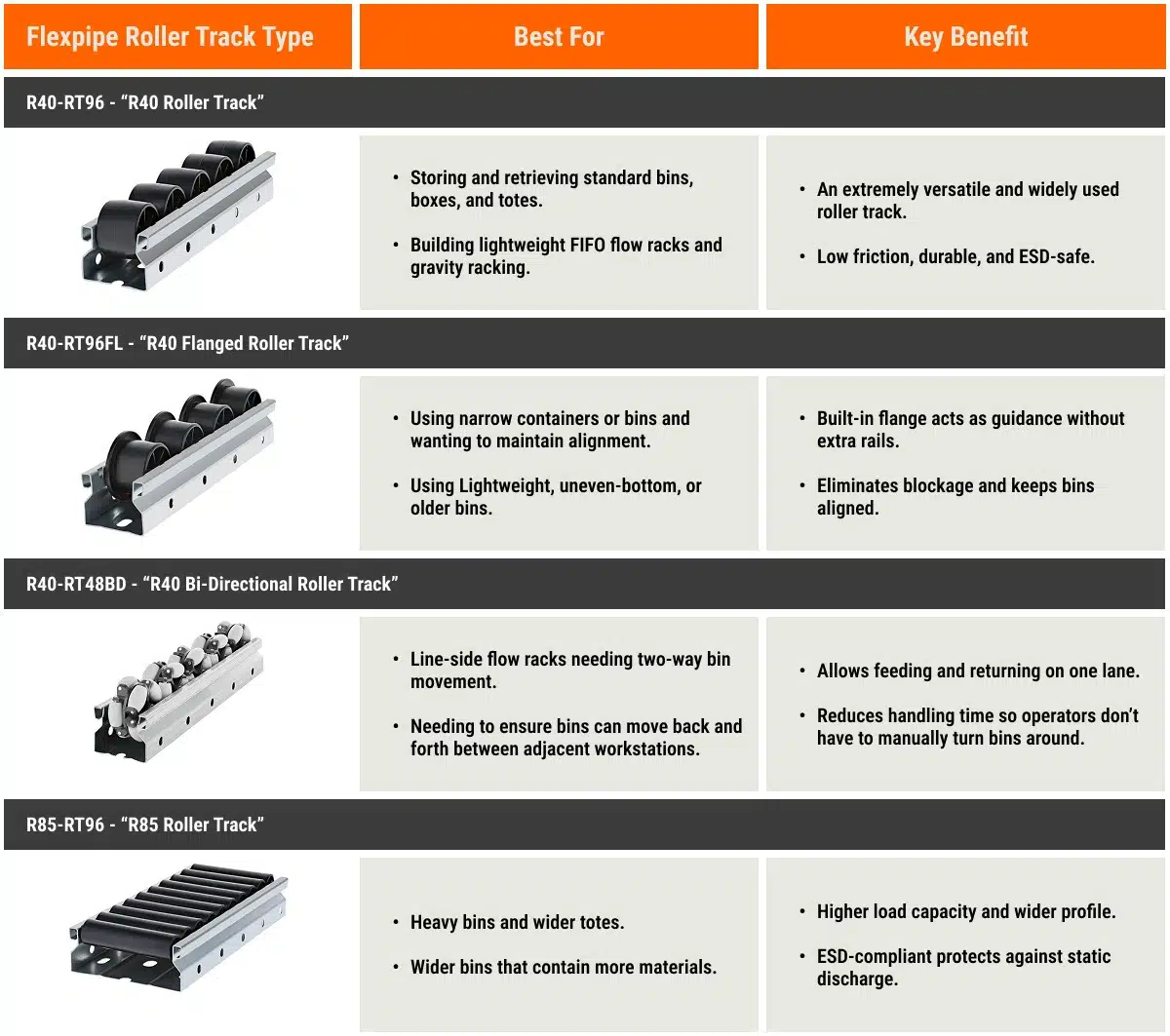
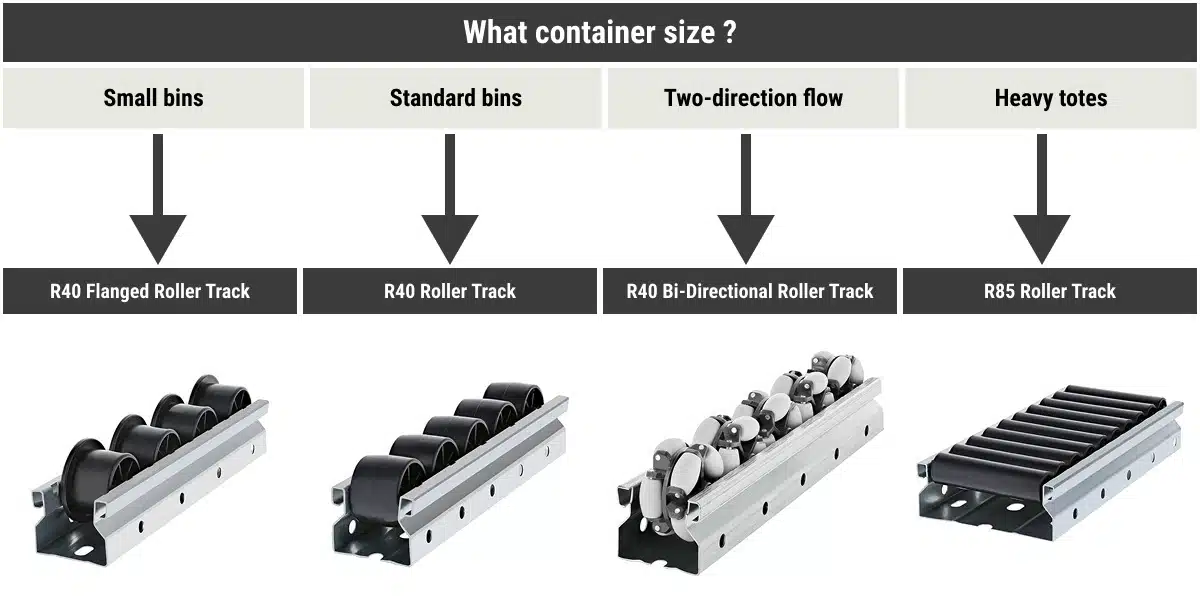
If you are using standard bins or totes, start with the R40 Roller Track. If your bins are narrow or need guidance, choose the R40 Flanged Roller Track. If bins need to move in both directions, use the R40 Bi-Directional Roller Track. For heavier or wider totes, choose the R85 Roller Track.
What Is a Roller Track?
A roller track is a gravity-fed rail used in flow racks to move bins, totes and cartons from one side of a rack to another. In most FIFO racks, materials are loaded from the rear and picked from the front.
This supports First-In, First-Out inventory control, which is especially useful for manufacturing, spare parts storage, food and beverage production, electronics assembly and warehouse replenishment.
A roller track helps reduce:
- Operator walking time
- Manual handling
- Searching for parts
- Material delays
- Poor bin presentation
- Inventory mix-ups
In lean manufacturing, this supports smoother material flow and improves workstation efficiency.
How Roller Tracks Work in FIFO Flow Racks
A FIFO flow rack uses gravity to move materials forward. The rack is built with a slight slope so that when one bin is removed from the front, the next bin rolls into position.
The Flexpipe source article notes that each roller track is commonly installed at around a 5-degree downward angle to help bins slide from the loading side to the picking side.
In simple terms:
- Inventory staff load bins at the back of the rack.
- Gravity moves the bins forward.
- Operators pick materials from the front.
- The next bin automatically moves into place.
This is why roller tracks are commonly used in line-side replenishment, where workers need reliable access to parts without leaving their work area.
Benefits of Roller Tracks
Roller tracks are popular because they are simple, modular and effective.
Main benefits include:
- No power required
- Smooth gravity-fed movement
- Supports FIFO inventory
- Reduces motion waste
- Improves line-side access
- Works with bins, totes and cartons
- Can be cut to length
- Supports modular rack design
- Helps improve productivity
For Australian businesses, this is useful because warehouse and manufacturing layouts often change. A modular Flexpipe system allows teams to adjust rack dimensions, lanes, levels and accessories without replacing the whole structure.
Types of Flexpipe Roller Tracks
1. R40 Roller Track
The R40 Roller Track is the standard and most commonly used roller track for Flexpipe flow racks. It is suitable for standard bins, totes and lightweight material handling applications.
Use the R40 Roller Track when:
- You are building a standard FIFO flow rack
- You use standard-sized bins or totes
- You need smooth line-side picking
- You want a versatile gravity rack solution
- Your materials are light to medium weight
This is usually the best starting point for most Australian warehouses and production lines.
2. R40 Flanged Roller Track
The R40 Flanged Roller Track includes built-in side guidance. This helps keep bins aligned as they move down the lane.
Use the R40 Flanged Roller Track when:
- Bins are narrow
- Bins drift sideways
- Bin bottoms are uneven
- Older containers are being used
- You want to reduce jamming
- You need better lane control
This option is useful for assembly areas where parts must be presented neatly and consistently.
3. R40 Bi-Directional Roller Track
The R40 Bi-Directional Roller Track allows bins to move in both directions. This is useful when material may need to travel back and forth between workstations.
Use the R40 Bi-Directional Roller Track when:
- You need two-way movement
- Workstations share bins
- Operators move materials both forward and backward
- You are designing flexible lean work cells
- You want to reduce manual turning of bins
This is ideal for kitting, assembly and transfer points between operators.
4. R85 Roller Track
The R85 Roller Track is wider and better suited to heavier bins, larger totes and higher-load applications.
Use the R85 Roller Track when:
- Bins are heavy
- Totes are wide
- You need more stability
- You are handling larger cartons
- Your application requires stronger support
- You work with ESD-sensitive components
This is often used in electronics, automotive, heavy parts storage and larger warehouse replenishment systems.
Roller Track Selection Matrix
How to Size a Roller Track Lane
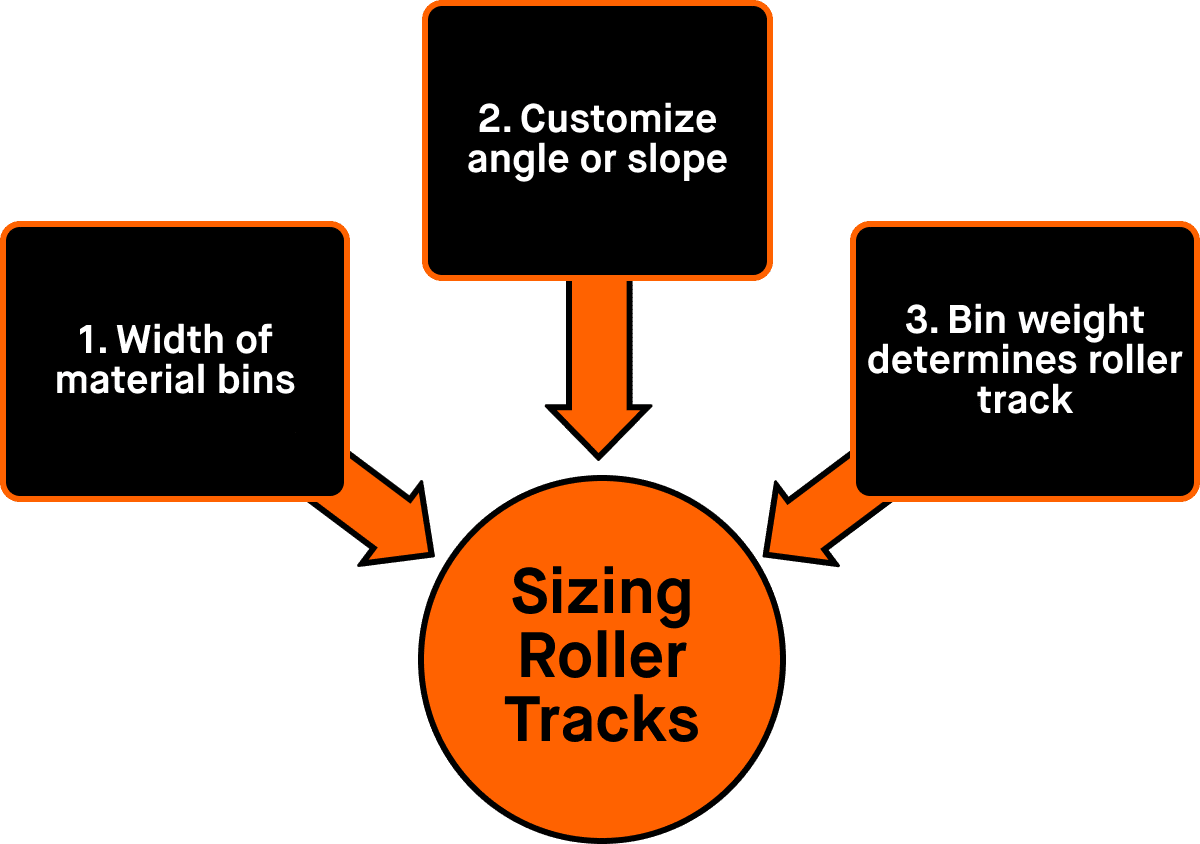
Choosing the right roller track is not only about the track type. You also need to size the lane correctly.
1. Measure the Bin Width
Start by measuring the actual width of your bin, tote or carton. The spacing between roller tracks must support the bin properly without allowing it to tip, jam or drift.
2. Check the Bin Weight
Light bins may need a steeper slope to move smoothly. Heavier bins may move too quickly and may need a lower slope or a decelerator.
3. Start With a 5-Degree Slope
For most FIFO racks, a 5-degree slope is a good starting point. However, you may need to adjust based on bin weight, surface type and lane length.
4. Test Before Finalising
Before building multiple rack lanes, test one lane with real bins and real materials. This helps confirm that the slope, spacing and roller type are correct.
Common Roller Track Accessories
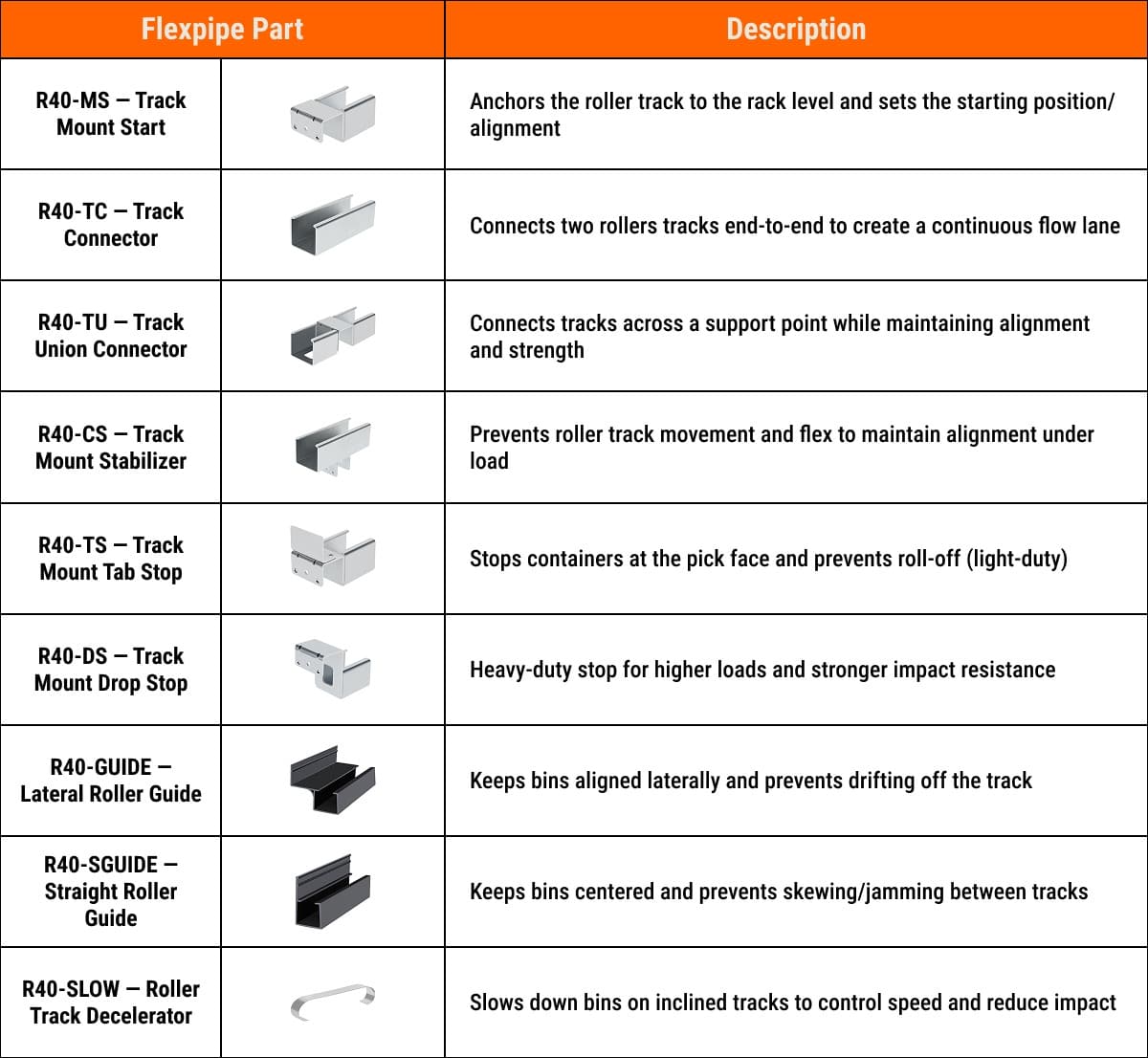
Accessories help control material movement and make the rack safer and easier to use.
Roller Tracks vs Skate Wheel Tracks
Roller tracks and skate wheel tracks are not the same.
For flow racks, roller tracks are generally the better choice because they provide controlled, straight-line material movement.
Common Flow Rack Design Mistakes
Many flow rack problems come from small design errors.
Best Applications for Roller Tracks in Australia
Roller tracks are suitable for many Australian industries, including:
- Manufacturing plants
- Automotive suppliers
- Electronics assembly
- Food and beverage production
- Mining supply warehouses
- Medical and pharmaceutical storage
- Third-party logistics warehouses
- Distribution centres
- Maintenance and spare parts stores
Common use cases include:
- FIFO flow racks
- Supermarket racks
- Kitting trolleys
- Picking trolleys
- Line-side replenishment racks
- Kanban storage
- Mobile gravity racks
- Warehouse replenishment lanes
Why Use Flexpipe Roller Tracks?
Flexpipe roller tracks are part of a modular pipe-and-joint system. This means your team can design, build and adjust material-handling structures as your operation changes.
Instead of using fixed welded racks, Flexpipe allows you to build:
- FIFO flow racks
- Picking trolleys
- Kitting carts
- Workstations
- Tugger carts
- Storage racks
- Lean work cells
For Australian facilities, this flexibility is valuable because product lines, bin sizes and warehouse layouts often change over time.
Conclusion
The right roller track depends on your bin size, bin weight, material flow direction and rack application.
For most flow racks, the R40 Roller Track is the best starting point. For narrow or unstable bins, use the R40 Flanged Roller Track. For two-way movement, choose the R40 Bi-Directional Roller Track. For heavier and wider totes, use the R85 Roller Track.
If you are planning a FIFO flow rack, gravity rack, picking trolley or line-side replenishment system in Australia, Flexpipe can help you design a modular solution that suits your workplace.
FREE PLAN LIBRARY
400+ pre-engineered plans, free to download
Carts, workstations, flow racks and more — get the full build plan in PDF or SketchUp or add the parts straight to your cart.
FAQs
1. What is a roller track used for?
A roller track is used in gravity flow racks to move bins, totes or cartons from the loading side to the picking side. It supports FIFO inventory and improves material flow.
2. Which roller track is best for FIFO flow racks?
The R40 Roller Track is the most common option for standard FIFO flow racks because it works well with standard bins and totes.
3. What is the difference between R40 and R85 roller tracks?
R40 roller tracks are suitable for standard bins and lighter loads. R85 roller tracks are wider and better suited to heavier bins, larger totes and more stable support.
4. When should I use flanged roller tracks?
Use flanged roller tracks when bins are narrow, uneven, older or likely to drift sideways. The flange helps guide the bin and keep it aligned.
5. Can roller tracks support FIFO systems?
Yes. Roller tracks are ideal for FIFO systems because they allow materials to move from back to front using gravity.
6. What angle should a roller track be installed at?
A 5-degree slope is a common starting point. However, the angle should be tested and adjusted based on bin weight, lane length and material type.
7. Are roller tracks better than skate wheel tracks?
For FIFO flow racks and lean manufacturing racks, roller tracks are usually better. Skate wheel tracks are more commonly used for packaging, shipping and carton movement.
8. Can roller tracks be used in Australian warehouses?
Yes. Roller tracks are widely used in Australian warehouses, production facilities and distribution centres for FIFO storage, picking, kitting and replenishment.
9. What accessories are needed with roller tracks?
Common accessories include track mounts, connectors, tab stops, drop stops, guides, stabilisers and decelerators.
10. Why choose modular Flexpipe racks instead of welded racks?
Modular Flexpipe racks can be adjusted, expanded or rebuilt when bin sizes, product lines or warehouse layouts change. Welded racks are fixed and less flexible.
Recent Articles