How to Optimize Warehouse: Smart Ways to Improve Space, Speed and Safety
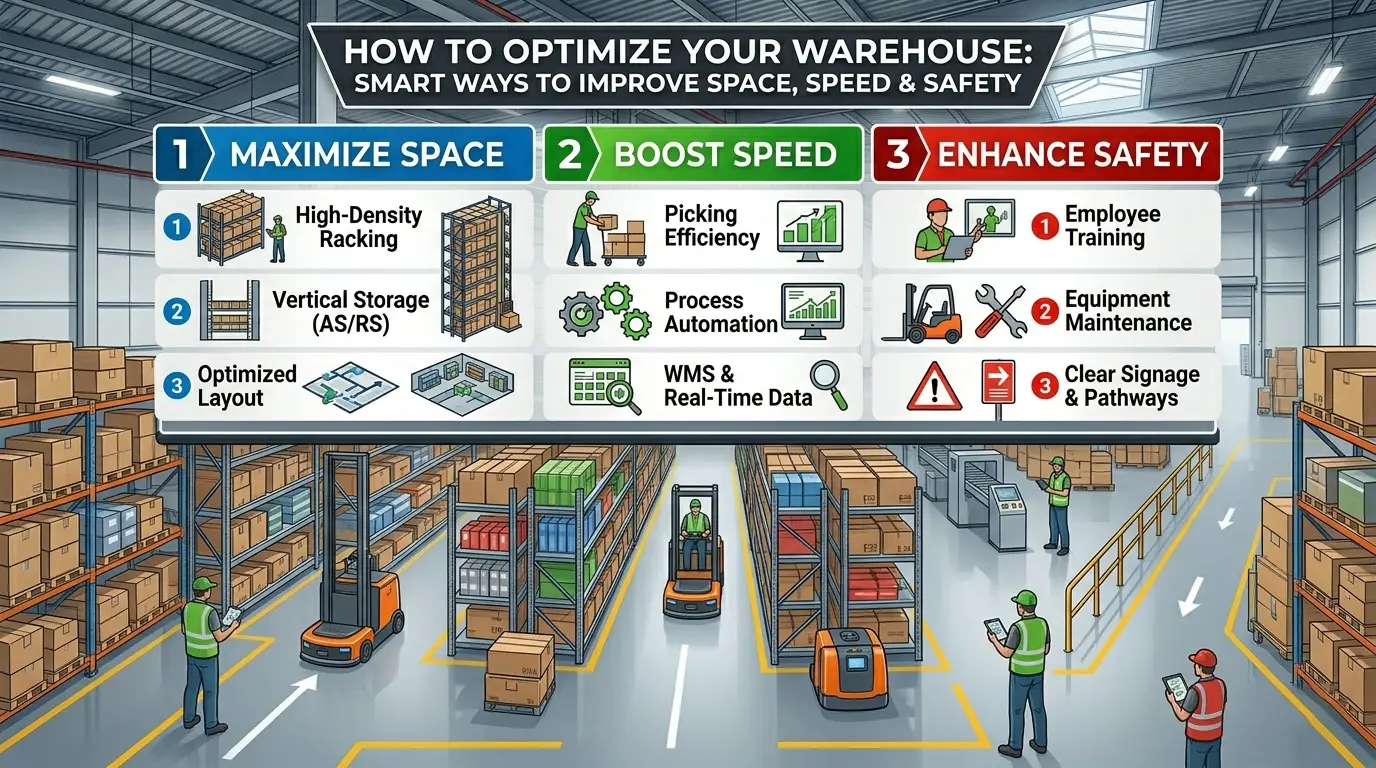
Warehouse performance can make or break a business. When operations run smoothly, orders move faster, labor is used better, and customers get what they need on time. When a warehouse is poorly organized, though, the opposite happens. Teams waste time walking, searching, lifting, and correcting errors. That drives up costs and slows down growth.
That’s why many operations leaders are asking the same question: How to Optimize Warehouse in a way that improves output without adding unnecessary complexity?
The answer usually starts with simple, practical changes. Better slotting, smarter layouts, clearer workflows, and ergonomic storage systems often create major gains before a company needs heavy automation. In many B2B environments, the biggest wins come from reducing motion, improving first-in, first-out flow, and making inventory easier to access and replenish.
A modern warehouse also needs flexibility. Product mixes change. Demand shifts. Floor space gets tighter. A fixed setup that worked last year may already be holding back performance today. That is where modular systems and lean material handling solutions become especially valuable.
Among these solutions, Flexpipe Flow Racks stand out for businesses that want a practical way to improve picking, replenishment, and floor organization. They help create smoother product flow while supporting safer and more efficient workstations. For B2B, looking for a scalable improvement that can be a powerful advantage.
How to Optimize a Warehouse with a Clear Operational Assessment
Before changing equipment or rearranging aisles, start with a full review of current operations. You need to know where time, space, and effort are being lost.
Review layout, travel paths, and bottlenecks
Walk the warehouse and observe how material moves from receiving to shipping. Watch where employees pause, backtrack, wait, or double-handle products. In many facilities, the biggest problem is not storage capacity alone. It is poor flow.
Look for:
- Congested aisles
- Long pick routes
- Overstocked staging areas
- Poorly placed fast-moving SKUs
- Repeated manual touches
Even small layout issues can create daily delays. A warehouse that looks busy is not always efficient.
Measure labor, storage, and order accuracy
Use basic metrics to build a baseline:
- Pick rate per hour
- Order accuracy
- Dock-to-stock time
- Inventory turnover
- Space utilization
- Replenishment frequency
Once you know where performance stands, it becomes easier to prioritize changes that will matter most.
Set warehouse goals that support business growth
Optimization works best when it supports clear business outcomes. Do you want faster fulfillment? Lower labor cost? Better space use? Fewer picking errors? Safer operations?
Align KPIs with service, cost, and throughput
The strongest warehouse strategies balance three needs:
- Service speed
- Cost control
- Operational flexibility
For example, a distributor handling many fast-moving parts may focus on pick speed and replenishment. A manufacturer may care more about line-side availability and FIFO storage. The right solution depends on the business model.
That said, nearly every warehouse benefits from cleaner flow, easier access, and less wasted motion.
FREE PLAN LIBRARY
Looking for a Ready-to-Build Layout?
Planning a FIFO flow rack, gravity rack, picking trolley or modular workstation? Save engineering time with 400+ free pre-engineered layouts designed for manufacturing, warehousing and lean production environments. Download detailed PDF or SketchUp plans.
Improve warehouse layout for better flow
Layout is one of the biggest factors in warehouse productivity. A smart layout reduces travel time and keeps each process in the right place.
Create logical receiving, storage, picking, packing, and shipping zones
Each warehouse function should have a clear purpose and location. Goods should move in one logical direction wherever possible. Avoid layouts that force products to cross paths unnecessarily.
A strong zone design:
- Keeps inbound and outbound traffic organized
- Separates reserve storage from active pick areas
- Supports smooth replenishment
- Reduces confusion for staff
Reduce unnecessary motion and forklift traffic
Too much movement is expensive. Long walks, extra reaches, and repeated forklift trips all add cost without adding value. Lean warehouse design aims to bring inventory closer to the point of use and reduce touches.
Flow rack systems are especially helpful here because they present products in an accessible way and support smoother replenishment from one side and picking from the other.
Use vertical space more effectively
Many warehouses run out of floor space long before they run out of total cubic space. Looking upward is often one of the easiest ways to gain capacity.
Maximize cube utilization without hurting access
The goal is not to stack inventory higher at any cost. The goal is to use height wisely while keeping fast-moving items easy to reach.
This means:
- Reserve the top levels for slower stock
- Keep active by picking in ergonomic zones
- Use modular structures that can be adjusted over time
A flexible racking strategy can help avoid expensive relocations or building expansions.
Slot inventory based on demand and movement
Not all items deserve the same placement. Smart slotting puts the right products in the right spots.
Place fast movers closer to pick zones
High-volume items should be near packing or shipping areas and stored for quick access. This reduces walking time and improves order speed.
Separate slow-moving and seasonal stock
Slow movers should not take up prime picking space. Seasonal items may need temporary areas that can expand or shrink as demand changes. This is another reason modular storage systems are useful. They adapt better than fixed installations.
Standardize material handling processes
A warehouse becomes more efficient when work is predictable and repeatable.
Build repeatable workflows for replenishment and picking
Standard work helps teams:
- Replenish in the same sequence
- Pick in the same method
- Reduce training time
- Improve accuracy
Visual controls, labeled lanes, and simple operating rules all help create consistency. The easier it is to follow the system, the more likely it is to succeed.
Reduce picking time with lean storage systems
Picking is often the most labor-intensive warehouse activity. Even modest improvements here can produce big savings.
Why flow racks improve first-in, first-out operations
Flow racks use gravity-fed lanes that move products forward as items are picked. That creates a natural first-in, first-out (FIFO) system, which is ideal for components, cartons, bins, and other fast-moving inventory.
Benefits include:
- Faster picks
- Better product visibility
- Reduced walking and reaching
- Easier replenishment
- Improved stock rotation
For businesses that handle repeat orders or assembly supplies, this can significantly improve speed and control.
How Flexpipe’s Flow Racks support fast-moving inventory
This is where Flexpipe’s Flow Racks deserve attention in warehouse strategy. The flow rack systems are designed to support lean material flow, efficient picking, and adaptable layouts. Because they are modular, businesses can configure them around specific products, workstations, or replenishment methods rather than forcing operations into a rigid setup.
Flexpipe’s Flow Racks are especially useful for:
- FIFO inventory management
- Kitting and assembly support
- Carton and bin handling
- Point-of-use storage
- Reducing travel in active pick zones
For buyers, that means the solution is not just storage. It is a way to improve throughput, ergonomics, and flexibility at the same time.
Strengthen inventory visibility and control
You cannot optimize what you cannot see. Inventory accuracy is central to warehouse performance.
Use barcode scanning and real-time tracking
Basic scanning and real-time inventory systems help teams:
- Find stock faster
- Reduce mis-picks
- Trigger replenishment on time
- Improve planning
When paired with well-organized storage like flow racks, visibility gets even better because products are easier to identify and access physically.
Improve warehouse ergonomics and worker safety
A productive warehouse should also be safer and easier on the body. Good ergonomics reduces fatigue and helps teams work more consistently across the day.
Cut bending, reaching, and manual strain
Storage systems should bring the product into the ideal work zone whenever possible. That lowers strain from awkward reaches, deep bending, and twisting. Flow racks can help by presenting inventory toward the operator, which improves access and supports smoother picks.
Safety improvements also include:
- Clear aisles
- Visual labels
- Stable storage lanes
- Reduced clutter
- Better line of sight
A safer warehouse usually becomes a faster warehouse too.
Train teams for consistency and continuous improvement
Even the best system fails if people are not trained to use it properly.
Cross-training and visual work instructions
Cross-trained employees can shift between receiving, replenishment, and picking as needed. This improves flexibility during peak periods. Visual work instructions also make processes easier to follow and reduce errors for new hires.
Good training should cover:
- Pick paths
- Replenishment rules
- Safety checks
- FIFO methods
- Equipment use
When warehouse teams understand why a system works, they are more likely to maintain it.
Automate the right tasks without overcomplicating operations
Automation can help, but not every warehouse needs a major robotics investment.
Choose practical automation for your warehouse size
Many facilities benefit more from simple upgrades, such as:
- Mobile scanners
- Print-and-apply labeling
- Conveyor support in key areas
- Digital inventory tracking
- Smart replenishment alerts
In many cases, lean physical storage improvements should come before high-cost automation. If the layout is poor, automation may only make a bad process faster.
Optimize replenishment to avoid stockouts and delays
A pick face is only useful if it stays stocked. Replenishment needs to be timely, simple, and visible.
Set minimum and maximum levels for active locations. Use clear triggers to restock before shortages affect picking. Flow racks can support this nicely because the replenishment side and pick side are separated, reducing interference and helping teams maintain continuous flow.
Use data to drive ongoing warehouse improvement
Warehouse optimization is not a one-time event. It is an ongoing process.
Track pick rate, dwell time, and inventory turns
Useful metrics include:
- Lines picked per labor hour
- Replenishment response time
- On-time shipments
- Order cycle time
- Space utilization
- Inventory turns
Review these regularly and tie them to process changes. When a new layout or storage solution improves performance, document it and expand what works.
Why modular systems are ideal for changing warehouse needs
Business needs rarely stay still. That is why fixed systems can become a problem over time.
Scale storage as SKUs and demand shift
Modular warehouse systems allow you to:
- Reconfigure lanes
- Add or remove levels
- Change footprint
- Support new product sizes
- Adjust to seasonal demand
For operations, this flexibility matters. It reduces the risk of investing in a layout that becomes outdated too quickly.
Flexpipe’s approach is strong here because modular flow racks can be adapted as operational needs change. That makes them a practical choice for growing manufacturers, distributors, and industrial businesses.
Common warehouse optimization mistakes to avoid
Many companies try to improve warehouse performance but miss the mark because they:
- Focus only on adding space instead of improving flow
- Keep fast movers in poor locations
- Ignore ergonomics
- Overcomplicate automation
- Fail to measure results
- Use rigid systems that cannot adapt
The best warehouse improvements are often simple, visible, and easy to sustain.
Why Flexpipe’s Flow Racks are a strong choice
If your goal is to improve warehouse flow without creating a costly or rigid setup, Flexpipe’s Flow Racks are worth serious consideration.
Modular design, FIFO support, and faster implementation
For buyers, Flexpipe offers several clear advantages:
- Modular configuration: systems can be built around your workflow
- FIFO functionality: supports better stock rotation
- Lean picking support: helps reduce wasted motion
- Ergonomic access: improves operator comfort
- Scalability: easier to adjust as needs change
That combination makes Flexpipe a smart fit for warehouses, assembly environments, and industrial operations that need practical performance gains. Instead of relying only on expensive technology, businesses can first improve the physical flow of materials with a system built for efficiency.
Conclusion
Understanding the best way to Optimize Warehouse operations is really about removing friction. The more you reduce wasted motion, improve access, support FIFO flow, and create a safer workspace, the more productive your warehouse becomes.
For many B2B companies, one of the most effective upgrades is a better storage and picking system. Flexpipe’s Flow Racks offer a practical way to improve material flow, support lean operations, and build a warehouse that can adapt as the business grows. That makes them more than a storage product; they are an operational improvement tool.
FAQs
- What is the first step in learning how to optimize warehouse operations?
The first step is to assess current performance. Review layout, labor movement, pick paths, storage use, and error rates. You need a baseline before making improvements.
- How do flow racks improve warehouse efficiency?
Flow racks present products at the pick face and use gravity to move items forward. This supports faster picking, better visibility, and FIFO inventory flow.
- Are Flexpipe’s Flow Racks suitable for operations?
Yes. They are well-suited for manufacturers, distributors, and industrial businesses that need scalable, modular, and ergonomic storage solutions.
- Can warehouse optimization reduce labor costs?
Yes. Better layout, smarter slotting, standardized processes, and efficient rack systems reduce wasted motion and help teams do more in less time.
- Is automation always necessary for warehouse optimization?
No. Many warehouses can improve dramatically through layout changes, better storage systems, inventory visibility, and process discipline before adding major automation.
- Why is FIFO important in a warehouse?
FIFO helps rotate stock properly, reduces aging inventory issues, and supports smoother replenishment. It is especially important for components, consumables, and time-sensitive products.
- What makes modular storage better than fixed storage?
Modular storage can be adjusted as inventory, SKUs, and workflows change. That gives businesses more flexibility and extends the value of the investment.
Recent Articles