Pipe Racking vs. Traditional Pallet Racking: Which One Wins in Lean?
 18 June 2025
In lean manufacturing, efficient material flow, space utilisation, flexibility, and safety are paramount. Choosing the right racking system—Flexpipe pipe racking or traditional pallet racking—can significantly impact your warehouse’s lean performance.
A Flexpipe Australia Pipe Racking System offers unmatched adaptability, making it ideal for facilities that prioritise lean operations and continuous improvement.
Below is a detailed comparison to help you decide which system best supports lean principles.
What is Pipe Racking?
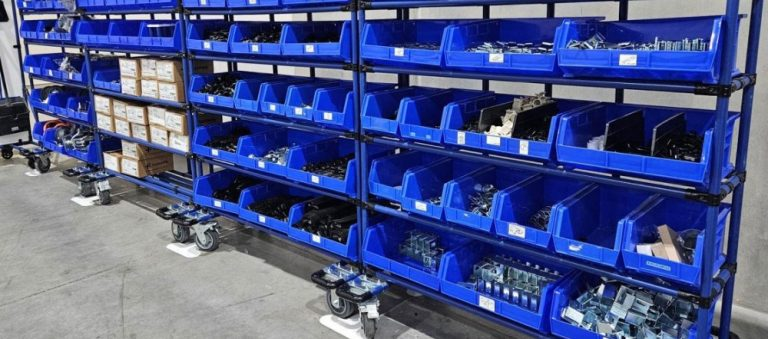
Pipe racking, often called lean tube or flow rack systems, uses modular pipes and joints to create custom storage and material handling solutions.
A Pipe Racking System can be configured for line-side storage, kitting, and ergonomic workstations, especially in high-mix, low-volume production settings.
Key Features
- Modular and reconfigurable design
- Lightweight yet strong
- Can be adapted for various products and processes
- Supports FIFO (First-In, First-Out) material flow
What Is Traditional Pallet Racking?
Traditional pallet racking is a fixed, steel structure designed to store palletised goods vertically. It is the most common warehouse racking system and is valued for its high storage density and direct access to each pallet.
Key Features
- Fixed structure, not easily reconfigured
- Supports heavy loads and high-density storage
- Suitable for a wide range of SKUs and pallet sizes
- Requires forklifts or material handling equipment for access
Head-to-Head Comparison
| Feature | Pipe Racking (Lean/Flow Rack) | Traditional Pallet Racking |
|---|---|---|
| Flexibility | Highly modular and reconfigurable | Fixed, requires major effort to reconfigure |
| Space Utilization | Maximizes vertical/horizontal space, compact, scalable | High density, but fixed footprint; empty racks still take space |
| Accessibility | Line-side, ergonomic, easy access | Direct pallet access, but requires equipment |
| Material Flow | Supports FIFO, reduces waste and travel | Good for large SKU variety, less suited for small-lot, just-in-time |
| Safety | Reduces bending/lifting injuries, better organization | Reduces product damage, requires safety features for forklift traffic |
| Cost | Lower initial cost, saves up to 50% warehousing costs, customizable | Economical for large-scale storage, but higher upfront for complex systems |
| Lean Suitability | Excellent for lean, supports continuous improvement, quick changes | Good for bulk storage, less agile for lean transformation |
Advantages of Pipe Racking in Lean
- Supports Lean Principles: The modular nature of a Pipe Racking System enables warehouses to optimize layouts and minimize non-value-added movement.
- Improved Ergonomics: Parts are presented at optimal height, reducing worker fatigue and injury.
- Space Efficiency: Maximizes use of vertical and horizontal space, freeing up floor space for value-added activities.
- Customizable: Can be tailored for specific parts, containers, or processes.
- Quick Implementation: Can be assembled and reconfigured rapidly, supporting continuous improvement and kaizen events.
Advantages of Traditional Pallet Racking
- High Storage Density: Ideal for bulk pallet storage and environments with many SKUs.
- Direct Access: Each pallet is accessible, supporting chaotic storage and fast picking for large inventories.
- Versatility: Can handle various weights, sizes, and types of goods.
- Cost-Effective for Scale: Economical for large warehouses with stable inventory and minimal process change.
Which One Wins in Lean?
Pipe racking is generally the superior choice for lean manufacturing environments. Its flexibility, modularity, and support for just-in-time and continuous improvement make it a natural fit for lean operations. It enables rapid reconfiguration, minimizes waste, and improves worker ergonomics and safety.
Traditional pallet racking excels in high-density, large-scale storage where inventory turnover is high and process change is minimal. However, it lacks the agility and adaptability that lean manufacturing demands.
Conclusion
- Choose pipe racking if your focus is lean manufacturing, frequent changeovers, small-lot production, or you need to support work cells and line-side delivery.
- Choose traditional pallet racking if you require high-density storage for many SKUs and your processes are stable and not subject to frequent change.
For most lean environments, pipe racking wins thanks to its flexibility, efficiency, and alignment with lean principles
Recent Articles