Continuous Improvement Process Definition & Methodologies: Powerful Strategies for Sustainable Growth
What is a Continuous Improvement Process?
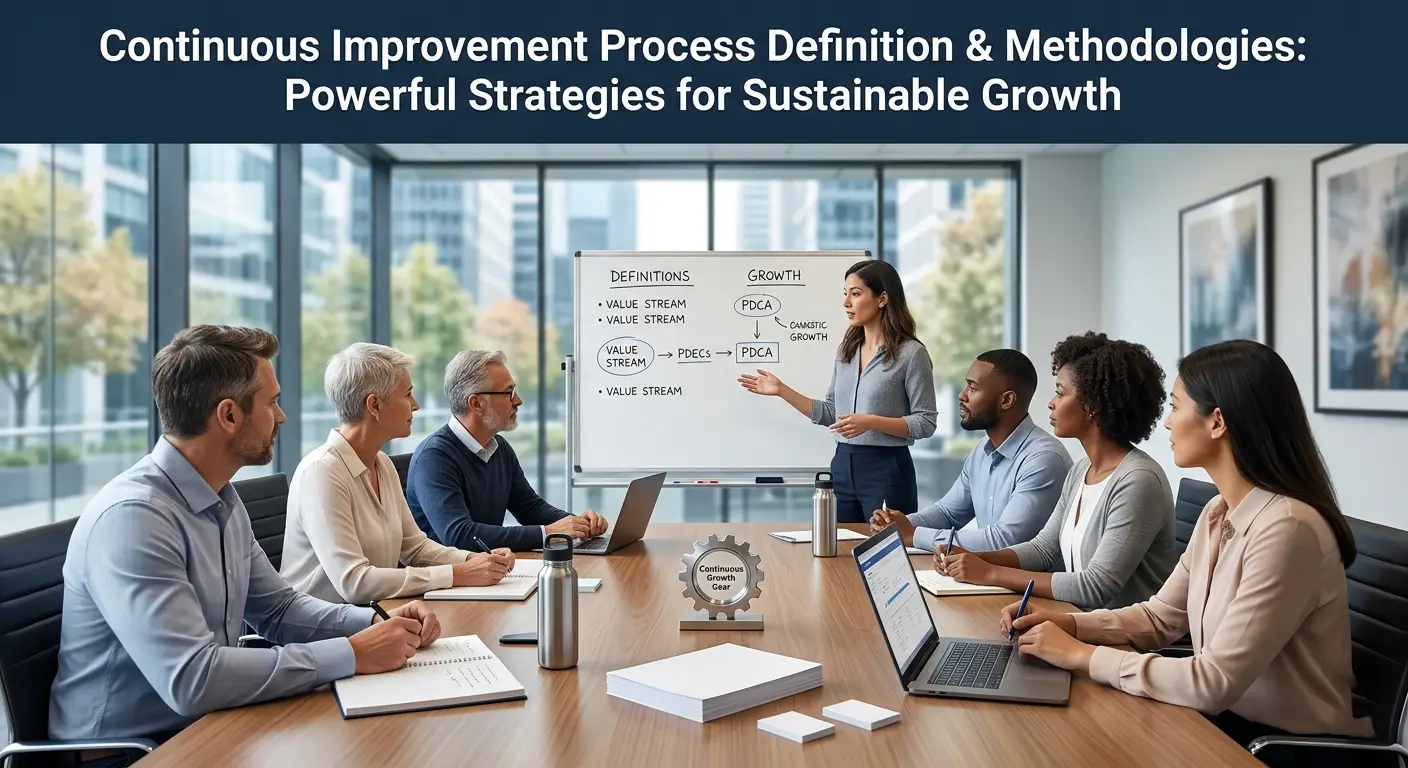
The Continuous Improvement Process revolves around the ongoing effort to enhance products, services, or processes through incremental improvements over time. Rather than making drastic changes, organizations focus on small, consistent upgrades that deliver long-term success.
At its core, this process encourages a culture where employees at all levels actively seek ways to improve efficiency, quality, and productivity. It’s not just a strategy, it’s a mindset.
Key Principles of Continuous Improvement
Continuous improvement is guided by several core principles:
- Small, incremental changes instead of large transformations
- Employee involvement at every level
- Data-driven decision-making
- Customer-focused improvements
These principles ensure that improvements are sustainable and aligned with business goals.
Benefits of Continuous Improvement
Organizations that adopt this approach experience numerous advantages:
- Increased operational efficiency
- Higher product quality
- Reduced waste and costs
- Improved employee engagement
- Enhanced customer satisfaction
Simply put, continuous improvement keeps businesses competitive and future-ready.
History and Evolution of Continuous Improvement
The concept originated in post-war manufacturing practices and gained popularity through Japanese management philosophies. Over time, it evolved into a global business standard.
Role in Lean Manufacturing
Continuous improvement plays a central role in lean manufacturing by eliminating waste and optimizing processes. It ensures that every step adds value, reducing inefficiencies.
Core Elements of Continuous Improvement
A successful improvement process includes:
- Feedback loops for ongoing evaluation
- Performance metrics to track progress
- Standardized workflows
- Employee training and engagement
Importance of Workplace Organization
An organized workspace enhances productivity and reduces errors. Visual management systems help teams quickly identify inefficiencies and act on them.
Popular Continuous Improvement Methodologies
Several methodologies support continuous improvement initiatives.
Kaizen Methodology
Kaizen focuses on continuous, incremental improvements involving everyone in the organization. It emphasizes teamwork and discipline.
Six Sigma
Six Sigma uses statistical tools to identify defects and improve quality. The DMAIC process (Define, Measure, Analyze, Improve, Control) is its backbone.
Lean Manufacturing
Lean eliminates waste and improves workflow efficiency. It ensures maximum value with minimal resources.
PDCA Cycle
The Plan-Do-Check-Act cycle provides a structured framework for testing and implementing improvements.
Tools Used in Continuous Improvement
Organizations rely on various tools, including:
- Flowcharts
- Root cause analysis
- Pareto charts
- Control charts
5S System
The 5S system improves workplace organization:
- Sort
- Set in order
- Shine
- Standardize
- Sustain
Role of Technology in Continuous Improvement
Technology plays a vital role by enabling automation, data collection, and real-time monitoring. Advanced software tools help organizations identify inefficiencies quickly and implement solutions effectively.
Enhancing Efficiency with Flow Racks
Material handling is a critical aspect of continuous improvement. Poor organization can lead to wasted time and reduced productivity.
This is where flow racks come into play.
Flow racks are designed to improve inventory management and streamline workflows. They use gravity-fed systems to ensure smooth movement of materials, reducing manual effort and errors.
Why Flexpipe Flow Racks Stand Out
Flexpipe Flow Racks are a game-changer for organizations aiming to enhance their continuous improvement initiatives.
Key advantages include:
- Modular design: Easily customizable to fit any workspace
- Improved efficiency: Faster access to materials
- Enhanced ergonomics: Reduces strain on workers
- Scalability: Adaptable to growing business needs
- Durability: Built for long-term use
By integrating Flexpipe’s Flow Racks, businesses can significantly improve workflow efficiency and support lean practices. These systems align perfectly with continuous improvement goals by minimizing waste and optimizing processes.
Challenges in Implementing Continuous Improvement
Despite its benefits, organizations may face challenges such as:
- Resistance to change
- Lack of training
- Insufficient leadership support
- Limited resources
Overcoming these barriers requires strong leadership and a clear strategy.
Best Practices for Success
To ensure success:
- Encourage employee participation
- Provide continuous training
- Set measurable goals
- Use data to guide decisions
- Celebrate small wins
Real-World Applications Across Industries
Continuous improvement is widely used in:
- Manufacturing
- Healthcare
- Logistics
- Retail
- IT services
Each industry adapts the methodology to suit its unique challenges.
Measuring Success in Continuous Improvement
Key performance indicators (KPIs) include:
- Productivity rates
- Error reduction
- Cost savings
- Customer satisfaction scores
Tracking these metrics helps organizations evaluate progress and refine strategies.
Future Trends in Continuous Improvement
The future is driven by:
- Artificial intelligence
- Smart factories
- Automation
- Data analytics
These innovations will make continuous improvement more efficient and impactful.
Conclusion
The Continuous Improvement process is essential for organizations striving for long-term success. By adopting proven methodologies like Kaizen, Lean, and Six Sigma, businesses can achieve sustainable growth.
Integrating smart solutions such as Flexpipe Flow Racks further enhances efficiency, ensuring smooth workflows and optimized operations. Continuous improvement isn’t just a strategy, it’s a commitment to excellence.
FAQs
- What is the main goal of a continuous improvement process?
The main goal is to enhance efficiency, quality, and productivity through ongoing incremental improvements.
- Which industries benefit most from continuous improvement?
Manufacturing, healthcare, logistics, and IT industries benefit significantly.
- How does Kaizen differ from Six Sigma?
Kaizen focuses on small, continuous changes, while Six Sigma emphasizes defect reduction using statistical analysis.
- What role do employees play in continuous improvement?
Employees are crucial as they identify inefficiencies and suggest improvements.
- Why are flow racks important in lean manufacturing?
They improve material flow, reduce waste, and enhance efficiency.
- How can Flexpipe Flow Racks support continuous improvement?
They streamline workflows, improve ergonomics, and reduce inefficiencies, making them ideal for lean environments.
Recent Articles