How to Select Industrial Work Surface for Workstations and Modular Structures
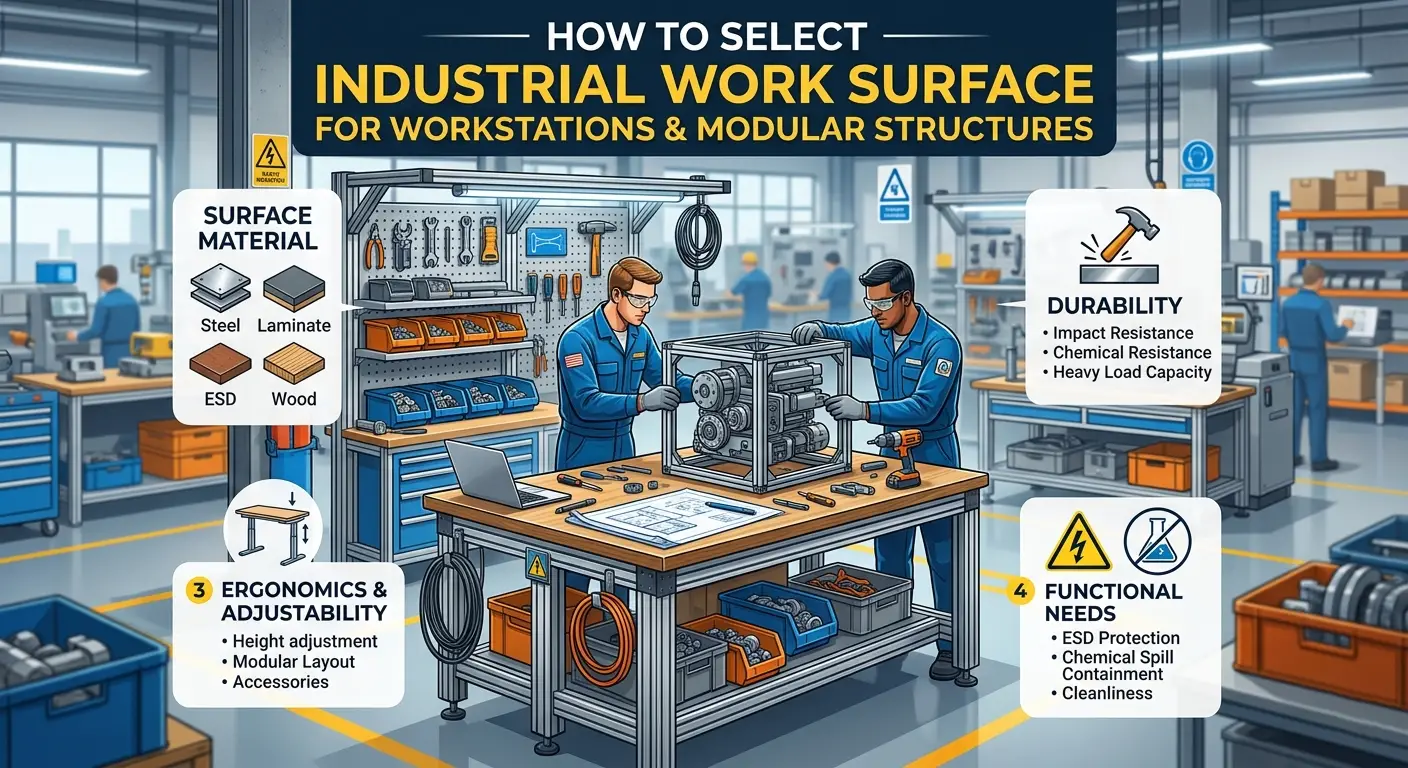
How to Select Industrial Work Surface for Workstations and Modular Structures: Expert Tips for Maximum Productivity
Industrial workstations are the backbone of modern manufacturing, assembly, and warehouse operations. Whether you operate a production line, packaging station, or maintenance cell, selecting the right industrial work surface directly impacts productivity, safety, and workflow efficiency.
In this post, we’ll explore how to select Industrial Work Surfaces for Workstations and Modular Structures, covering materials, load capacity, ergonomics, durability, and compatibility with modular systems. We’ll also explain how modular solutions like the Flexpipe modular system help companies build flexible, future-ready workstations.
How to Select Industrial Work Surface for Workstations and Modular Structures
Why the Work Surface Matters in Industrial Workstations
The work surface is the core functional area of any workstation. Workers perform assembly, inspection, packaging, and repair tasks on it every day. Choosing the wrong surface can lead to:
- Reduced productivity
- Higher maintenance costs
- Ergonomic issues for operators
- Safety risks
- Inefficient workflow layouts
Modern manufacturing environments prioritize ergonomic, adaptable, and durable workstations to support lean manufacturing practices and operator efficiency. Modular workstation systems are particularly effective because they allow layouts and components to be reconfigured as production needs evolve.
Key Factors to Consider When Selecting an Industrial Work Surface
1. Type of Work Performed
The first step in selecting the right surface is understanding the nature of the task performed at the workstation.
Different tasks require different surface properties:
| Application | Recommended Surface |
| Light assembly | Laminate or hardwood |
| Heavy manufacturing | Steel or reinforced composite |
| Electronics assembly | ESD-safe surface |
| Packaging | Smooth laminate or stainless steel |
| Inspection stations | Anti-glare surfaces |
For example:
- Electronics assembly requires ESD-safe surfaces to prevent electrostatic discharge damage.
- Heavy machining requires impact-resistant steel surfaces.
Selecting the right surface ensures both worker efficiency and product safety.
2. Load Capacity and Structural Strength
Industrial work surfaces must support both static and dynamic loads.
Consider:
- Equipment weight
- Tooling loads
- Material handling loads
- Operator pressure during assembly
High-load environments require:
- Reinforced steel frames
- Composite industrial panels
- High-density worktops
Modular structures built using systems like Flexpipe combine steel pipes and industrial connectors, allowing strong workstation frames that support heavy loads while remaining adjustable.
3. Durability and Surface Resistance
Manufacturing environments expose work surfaces to:
- Chemicals
- Oils
- Impact
- Abrasion
- Heat
Choose materials that resist these elements.
Common industrial surface materials
| Material | Advantages | Best Use |
| Stainless Steel | Corrosion resistant | Food, pharma |
| Hardwood | Strong and repairable | Mechanical assembly |
| Laminate | Cost-effective | Packaging |
| Composite | Durable & lightweight | General manufacturing |
| ESD laminate | Static control | Electronics |
Durability directly affects long-term maintenance costs.
4. Ergonomics and Operator Comfort
An ergonomic workstation reduces:
- Worker fatigue
- Injury risks
- Cycle times
Important ergonomic features include:
- Adjustable work surface height
- Proper reach zones
- Tool accessibility
- Anti-fatigue support
Research shows that well-designed ergonomic workstations can reduce cycle times and improve productivity in assembly environments.
Modern modular systems allow manufacturers to easily adjust workstation height, shelving, and accessories for different operators.
5. Surface Size and Workspace Layout
Selecting the correct surface dimensions ensures:
- Efficient workflow
- Minimal operator movement
- Organized tools and materials
Consider:
- Tool placement
- Material bins
- Documentation displays
- Lighting systems
In lean manufacturing, workstation layout is optimized to minimize motion waste and improve efficiency.
U-shaped or U-cell workstation designs are often used in assembly environments because they improve flow and reduce unnecessary movement.
6. Compatibility with Modular Structures
Traditional welded workstations are difficult to modify.
In contrast, modular systems provide flexibility.
Benefits include:
- Fast reconfiguration
- Easy expansion
- Component reuse
- Reduced redesign costs
The Flexpipe modular system uses steel pipes and connectors to build customizable workstation frames, carts, racks, and assembly cells.
Because these structures require no welding and minimal tools, companies can quickly adapt workstations to changing production needs.
Why Modular Workstations Are the Future of Industrial Workspaces
Traditional welded structures were once standard in manufacturing facilities. However, modern operations increasingly adopt modular workstation systems because of their flexibility.
Advantages of Modular Workstations
1. Easy Reconfiguration
Production requirements constantly change.
Modular workstations allow teams to:
- Adjust layouts
- Add shelves
- Change workstation size
- Move structures
without replacing the entire system.
2. Faster Implementation
Unlike welded steel structures, modular systems:
- Require no welding
- Use simple hand tools
- Assemble quickly
This reduces installation time and downtime.
3. Lower Lifecycle Costs
Even if modular systems require moderate initial investment, they often provide 30–50% lifecycle savings due to component reuse and flexibility.
4. Lean Manufacturing Compatibility
Modular systems support:
- 5S methodology
- Kaizen improvements
- Continuous process optimization
This makes them ideal for modern manufacturing environments focused on efficiency and waste reduction.
Flexpipe Modular System for Industrial Workstations
One of the most widely used modular solutions is the Flexpipe Modular System.
It is designed specifically for lean manufacturing and material handling environments.
Key Features of Flexpipe Modular Systems
Pipe-and-Joint Construction
The system uses:
- 28 mm steel pipes
- metal joints
- rollers
- casters
- accessories
These components connect to create highly customizable industrial structures.
Highly Customizable Workstations
Flexpipe structures can be used to build:
- Assembly workstations
- Packing tables
- Flow racks
- Mobile carts
- Tool stations
- Inspection benches
Because the system is modular, structures can be expanded, reconfigured, or repurposed without replacing the entire frame.
Supports Lean Manufacturing
Flexpipe workstations are designed to:
- Reduce motion waste
- Improve tool organization
- Optimize workspace layouts
Operators can easily integrate shelves, shadow boards, and bins for efficient production.
Durable and Cost-Effective
Flexpipe structures are built with coated steel pipes and industrial connectors, providing durability for demanding manufacturing environments while remaining lightweight and easy to assemble.
Industries That Benefit from Modular Workstations
Industrial work surfaces combined with modular structures are used in many industries:
- Automotive manufacturing
- Electronics assembly
- Aerospace production
- Warehouse logistics
- Packaging operations
- Medical device manufacturing
These sectors rely on flexible and ergonomic workstations to maintain productivity and quality standards.
Best Practices for Designing Industrial Workstations
To maximize efficiency, follow these design principles:
1. Follow Lean Manufacturing Principles
Eliminate unnecessary movement and clutter.
2. Keep Tools Within Reach
Use shadow boards and shelves.
3. Standardize Workstations
Maintain consistency across production lines.
4. Allow Adjustability
Different operators require different heights.
5. Plan for Future Expansion
Use modular systems rather than fixed structures.
Conclusion
Choosing the right industrial work surface is critical for improving productivity, safety, and workflow efficiency. Factors such as material durability, ergonomics, load capacity, and compatibility with modular structures should always be considered.
Modern manufacturing facilities are increasingly shifting toward modular workstation solutions because they provide flexibility, scalability, and long-term cost savings.
Solutions like the Flexpipe modular system enable manufacturers to design adaptable workstations that evolve with their production needs, helping businesses implement lean manufacturing practices while creating safer and more efficient workplaces.
FAQs
- What is the best material for an industrial workstation surface?
The best material depends on the application. Stainless steel works well for hygienic environments, hardwood for mechanical assembly, and ESD laminate for electronics manufacturing.
- What is a modular workstation?
A modular workstation is a workstation built from interchangeable components that can be adjusted or reconfigured to suit different tasks or layouts.
- Why are modular systems better than welded structures?
Modular systems are easier to modify, quicker to assemble, and allow component reuse, reducing long-term costs.
- Can modular workstations support heavy loads?
Yes. Many modular systems use reinforced steel components capable of supporting heavy industrial loads.
- What industries use modular workstations the most?
Automotive, electronics, aerospace, logistics, and manufacturing industries commonly use modular workstation systems.
- What is the Flexpipe modular system used for?
The Flexpipe modular system is used to build customizable industrial structures such as workstations, racks, carts, and assembly cells for lean manufacturing environments.
Recent Articles